

Rural Workers Are Suffering As Maharashtra’s Drought Worsens. The State Government Must Act Now
A crisis is brewing in Maharashtra. Last week, ISWA representatives travelled through Marathwada, the eastern region of the state, where drought has been officially declared in 74 of 76 talukas. What we saw shook us.
Much of the region’s sugarcane has dried up, and along with it, the jobs that farmworkers depend on to feed their families. Workers are suffering from unemployment, income loss, and distress migration, and the situation is rapidly getting worse. The government has announced relief measures, but support is not reaching the people who need it most. Maharashtra must immediately act to protect the rights and lives of rural workers. Below, we explain how.
From October 6th to 9th we drove through miles of thinned-out sugarcane, cotton, and soybean fields, each covered with barely a shadow of their normal crop. There, we spoke to dozens of farmworkers and farmers. Nearly every person we spoke to told us that this year’s drought is the worst they have seen in decades, and local labour organizers said that some residents are already running out of drinking water. Drought has been officially declared in 305 of Maharashtra’s 358 talukas, and northern parts of Karnataka—where a large number of workers from Marathwada will soon move for jobs cutting sugarcane—have been hit hard as well.
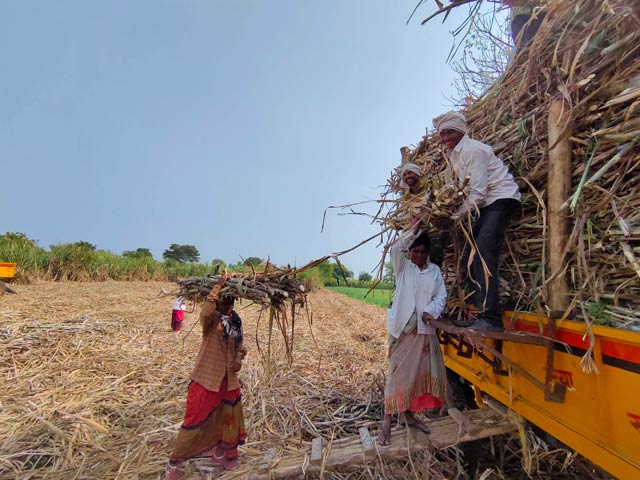
Those experiencing the worst consequences are the rural workers who migrate to and from Maharashtra to cut sugarcane. The drought has shortened the sugar harvesting season, which usually runs from November to March. As a result of this year’s poor crop, many farmers have scaled back their usual hiring, eliminating the jobs that workers depend on to feed their families. In the farms that still have jobs to offer, workers are set to earn far less money than usual, since they are paid by the weight of the crop they harvest, and 75% of a sugarcane’s weight is water. As a result, thousands of workers and their families, most of whom already live below the national poverty line, will not be able to afford their basic necessities—medicines, clothing, and food.
If they are unable to get a job cutting sugarcane, workers usually turn to local agriculture jobs like harvesting soybeans instead. Yet this year, those jobs will be scarce too. The drought has affected all crops—not just sugarcane. Near Mazalgaon in the Beed district, we spoke with a soybean farmer who told us that this season, his farm had produced less than 20% of its usual crop. Facing steep losses, he chose not to hire any workers this season. With no work to be found at home or nearby, thousands of workers may be driven into distress migration, having to travel hundreds more miles than usual in search of food and pay for their families.
Maharashtra has weathered droughts before using policies that are designed to protect its most vulnerable workers—but currently, these laws are not being properly applied. In particular, two policies require urgent change.
First, the government must ensure that the VB-G RAM G (rural guarantee for employment and livelihood) scheme is implemented appropriately. The scheme guarantees that rural workers who file a work request be provided with paid manual jobs in their local community by their panchayat government. Yet numerous farm workers and labour groups we spoke to told us that they had not received work under VB-G RAM G, despite requesting it from their panchayats weeks ago. Additionally, receiving work did not always mean receiving drought relief. Many workers told us they had been given difficult or impossible tasks which they could not complete and earn wages for. In one village, a union of women workers told us that after requesting work, they had been tasked with digging a 20-foot well in ground made of hard rock – a near-impossible job for any rural worker, never mind a group of elderly women without access to specialized equipment.
These stories highlight major VB-G RAM G misapplications that the government of Maharashtra must immediately address. All workers who request employment must be provided it, and the jobs that they receive must be ones they are genuinely capable of accomplishing. If workers were improperly denied either of these over the past 125 days, they should be granted compensation equal to the daily minimum wage they would have otherwise received.
Second, the government must ensure that its emergency drought relief payments go to rural workers as well as farmers. Existing national and state law requires the government to provide economic compensation to affected communities during intense droughts. While the state government recently announced that it will be sending relief payments to farmers before Diwali through a Comprehensive Drought Package, it has not announced any plans to provide compensation for rural workers—who are suffering just as much. This follows a consistent failure in drought compensation policy, where relief is provided on the basis of the acreage one owns—leaving landless workers, who are a majority of agricultural workers, without any emergency relief. This shortcoming must be addressed: the Comprehensive Drought Package should be amended to provide 3 months’ wage compensation to rural workers in all drought affected talukas, in addition to the money that is designated for farmers.
Maharashtra is India’s largest sugar-producing region. We all rely on the food produced by the industry—and, in turn, on the 1.5 million rural workers who harvest cane in Maharashtra each year. Yet right now, the people who feed the country are being left hungry. Their wages, jobs, and security have disappeared along with this year’s harvest. No one—neither the food and beverage companies who profit from rural workers’ labour, nor the government charged with protecting their rights—can afford to look away. Sugarcane industry workers deserve solidarity and justice. The government of Maharashtra must provide them with immediate relief.
For more details please contact:
indiafairfood@gmail.com